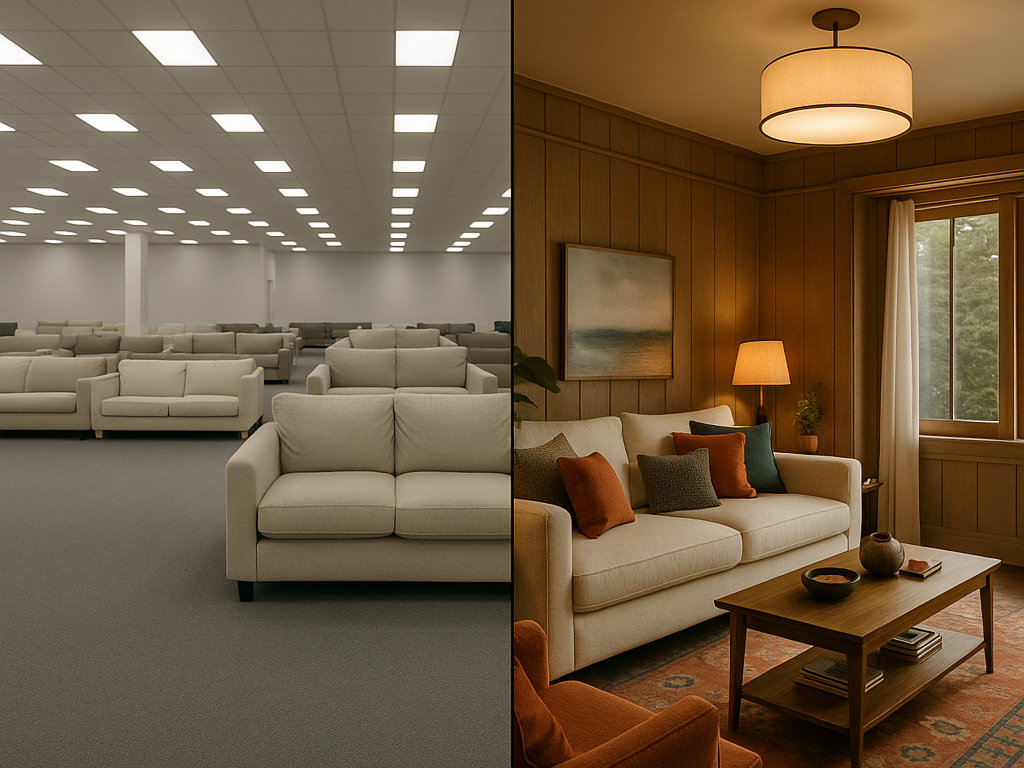
People make better decisions about furniture, art, decor, and even everyday home essentials when they can experience them the way they are meant to be used, in real life rather than under showroom lighting.
A traditional showroom might display a sofa or a lamp, but a beautifully designed boutique hotel, a well-curated vacation rental, or a character-rich restaurant does something far more powerful: it lets people live with the product.
This kind of natural, unforced experience builds confidence and connection in ways no staged retail environment can match. Research in embodied cognition shows that physical interaction such as touch, comfort, and movement shapes perception and increases desirability. When people experience a product in context, they understand it more fully and appreciate it more deeply.
The best way to inspire a purchase is to let people experience the product in a space that feels real.
The Magic of Context: Why Experience Creates Desire
Furniture and home goods are deeply contextual. A chair looks different depending on the room. A rug feels different depending on the light. A lamp transforms from decorative object to emotional experience once it's illuminated at night.
Context-rich environments do three things exceptionally well:
- They spark imagination. When a space is thoughtfully designed, consumers do not have to guess how something will look; they can see it.
- They reduce decision fatigue. Showrooms are overwhelming. Real spaces are intuitive. A cohesive room tells a story, and consumers follow it naturally.
- They inspire emotional connection. People respond to spaces that feel warm, intentional, and lived-in. Those feelings transfer to the products within them.
This is why experiential retail consistently outperforms traditional retail. The environment does the selling.
Experience Removes the Biggest Barrier: Uncertainty
Buying furniture or home goods comes with layers of uncertainty:
- Will this feel durable?
- Does it look as good in real life as it does online?
- Will these colors work in my home?
- Will this plate, this lamp, this chair still feel right after repeated use?
When someone interacts with a product naturally by sitting on it, touching it, walking past it throughout the day, and experiencing it in real use, uncertainty dissolves. What remains is confidence, and confidence drives purchases.
Proof in the Real World: IKEA and Casper
IKEA: Selling Through Simulated Living
IKEA doesn't rely on aisles of isolated products. Instead, it creates fully curated "micro-homes" that demonstrate how furniture, carpets, art, lighting, and decor work together. Customers explore lifestyles, not products, and their baskets grow accordingly.
Casper: The Power of Use Over Display
Casper recognized that people can't evaluate a mattress by sight alone. Their "nap rooms" invited customers to actually use the product, proving that experience drives conversions more effectively than traditional retail demos.
Although these industries differ, the underlying principle is identical. When people experience products as they're intended to be used, they're far more likely to buy them.
Where Showrooms Fall Short and Real Spaces Shine
Showrooms struggle with sensory overload and artificiality. Nothing feels personal, or lived-in.
But when you encounter a beautifully curated space in the wild, everything changes. Lighting is natural. Furniture is placed with purpose. Art has a story. Tableware and kitchen products are actually used.
These lived environments don't just show products, they demonstrate them. They build trust, inspire taste, and create desire.
Curadeco: Turning Every Space Into a Curated Showroom
At Curadeco, we believe that the best product discovery happens in the physical world, where people experience design the way it was meant to be enjoyed.
Boutique hotels, restaurants, cafes, and vacation rentals already curate remarkable spaces. Their guests are already engaging with furniture, art, decor, carpets, lighting, tableware, and everyday essentials. But until now, there has been no seamless way to turn that interaction into commerce.
Curadeco changes that.
- Build Virtual Storefronts — Venue owners add the products featured in their space—sofas, chairs, barware, art, rugs, lamps, linens, kitchen accessories, and more.
- Place Elegant QR Codes — Guests can scan to instantly explore and purchase the exact items they're experiencing.
- Earn From Curation — Venue owners receive a share of affiliate revenue—finally getting rewarded for the design expertise and taste that make their spaces extraordinary.
This model bridges the gap between inspiration and acquisition. Guests discover products in the context where they shine. Spaces earn more by doing what they already do well, curating beautiful environments. And consumers get access to products they've lived with and loved.
The Future of Retail Is Experiential
Digital ads are noisy. Traditional showrooms feel disconnected. What actually works is real experience in real spaces.
Curadeco empowers tastemakers to turn their environments into immersive, intuitive, revenue-generating showrooms. Not by adding friction, but by revealing the value that was already there.
When design is lived, it becomes powerful. When discovery is natural, it becomes memorable. And when experience leads the way, everyone wins.
Ready to monetize your space?
Join venues already earning from the products guests love.
Request Access